

The Train to Exile
Saint Raphael Kalinowski on Scripture, suffering, and the road to Siberia

“On the night of March 12 or 13 according to the old style calendar, at midnight I was woken suddenly: ‘is Joseph Kalinowski, a former captain of engineering here?’ I was asked in a loud voice, ‘this is the police chief.’ He asked me to open my desk, then he grabbed some papers that fell into his hands; this job didn’t seem to please him much and after this exercise he said to me somewhat apologetically, ‘Pardon me, I have been ordered to arrest you.’ I gave in without objection.”
Kalinowski’s spiritual growth would deepen enormously during his years of exile and imprisonment. His devotional life would center on the Eucharist and dedication to Mary, the mother of Jesus, so natural for a Pole.
After some intervention by influential friends, the death penalty was commuted to ten years of hard or forced labor in the salt works of Siberia. Kalinowski was transferred to another prison where he did have access to Mass and the sacraments.
The time for departure duly arrived. He took with him into exile a copy of the New Testament, together with the book of Job and the Psalms, the Imitation of Christ, and his crucifix. Having in mind the biblical command, “pack your bag for exile” (Jer 46:19), Kalinowski relates:
“On June 29, 1864, the long terrible march began. On the very feast of the solemnity of the Holy Apostles Peter and Paul, near midday, the long file that we made up snaked its way through the streets of Vilnius toward the train station. An enormous crowd lined the streets and Cossacks on horseback prevented anyone from coming close to us; many people were watching from their windows. It looked like a funeral cortège. But from the beginning of the insurrection how many such convoys had preceded us! Among us were people of every age and every condition ... We took our places in the train cars, where they piled one person on top of another. ... When the train departed, people moving along the heights that dominated the railway threw flowers on it as they do on graves of the dead at cemeteries.”
— Timothy Tierney, o.c.d.
Saint Raphael Kalinowski, ch. 4
⬦ Reflection Question ⬦
What strikes you about the items Saint Raphael Kalinowski took with him into exile?
⬦ Join the conversation in the comments.
Source reference
Tierney, Timothy. Saint Raphael Kalinowski: Apprenticed to Sainthood in Siberia. Bloomington, IN: Balboa Press Australia, 2016.
Featured image
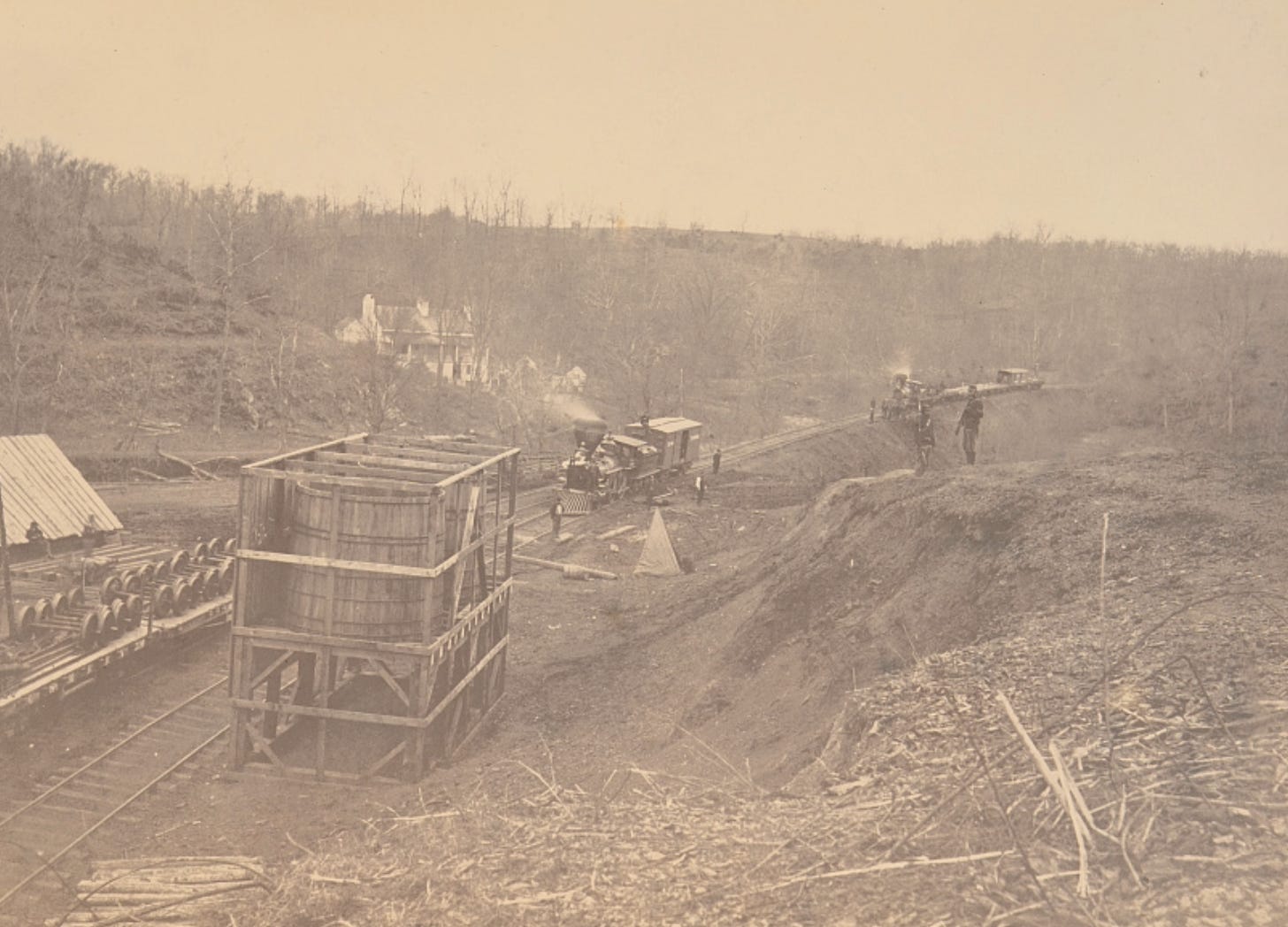
Union Mills Station on the Orange & Alexandria Railroad in Clifton, Virginia, 1863–1865.
Image credit: Andrew J. Russell / Library of Congress, Prints and Photographs Division. Reproduction no. LC-DIG-ppmsca-80138. No known restrictions on publication.
Job, the Psalms, Imitation of Christ and a Crucifix would be powerful resources for praying through the injustice and suffering he would undergo.
I noticed immediately that he didn't pack his breviary. I'm wondering how I'd do if I didn't have my breviary in exile.